
Why BIS certification isn’t optional anymore in India’s compliance-first market
There was a time when compliance felt like paperwork. Today, it’s the price of entry. In India’s tightening regulatory landscape, skipping BIS certification isn’t just risky—it’s commercially fatal. Products without it don’t just lose credibility; they lose access.
At its core, BIS (Bureau of Indian Standards) certification is India’s way of drawing a hard line on safety, quality, and reliability. If your product doesn’t meet the prescribed Indian Standards (IS), it doesn’t belong on the shelf—simple as that.
And in 2026, the stakes are higher than ever. With Quality Control Orders (QCOs) expanding across sectors and enforcement getting sharper, non-compliance can trigger product bans, heavy fines, or worse—business disruption at scale.
This guide cuts through the noise.
What you’ll get: a clear, step-by-step walkthrough of the BIS certification process—from the first application click to final approval—without the usual regulatory fog.
Quick Snapshot:
- Timeline: 30–120 days (depending on scheme)
- Certification Routes: ISI, CRS, FMCS
- Outcome: Legal market access + product credibility
What is BIS Certification?
BIS certification is not just a label—it’s a regulatory assurance mechanism. Issued by the Bureau of Indian Standards, it confirms that a product meets specific Indian Standards (IS) for quality, safety, and performance.
Think of it as a filter: only products that pass through it are allowed to circulate freely in the Indian market.
The Role of Indian Standards (IS)
Indian Standards are the technical backbone of BIS certification. They define:
- Product specifications
- Safety benchmarks
- Testing methods
- Quality thresholds
Every certified product is measured against these parameters—no shortcuts, no approximations.
Who Needs BIS Certification?
BIS certification applies across the supply chain:
- Manufacturers (India): For producing and selling regulated goods
- Importers: To legally bring products into India
- Foreign Manufacturers: To access the Indian market under compliance frameworks
If your product falls under a notified category, certification isn’t optional—it’s mandatory.
Understanding the Key Certification Schemes
ISI Mark (Domestic Manufacturers): The most recognized BIS mark. Applied to products manufactured in India, it involves factory inspections and product testing before approval.
CRS (Compulsory Registration Scheme): Primarily for electronics and IT products. A self-declaration-based system, where manufacturers register products after testing in BIS-recognized labs—no factory audit required.
FMCS (Foreign Manufacturers Certification Scheme): Designed for overseas manufacturers exporting to India. It mirrors the ISI process but includes international audit and compliance checks.
BIS Certification Process: Step-by-Step Breakdown
This is where intent meets procedure. The BIS certification journey isn’t easy. it’s structured. Miss a step, and you stall. Get it right, and the system moves with you.
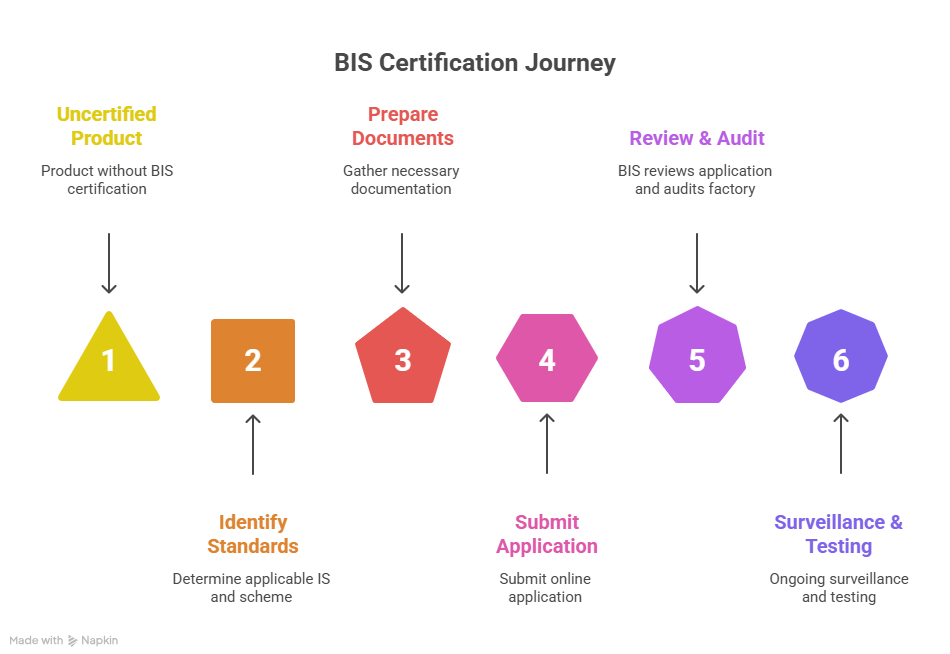
Step 1: Identify Applicable Standards & Scheme
Everything begins here—and if you get this wrong, everything that follows unravels.
Start by identifying the correct Indian Standard (IS) for your product. Each category—whether electrical appliances, steel products, or electronics—maps to a specific benchmark. This isn’t guesswork; it’s classification.
Next, choose the right certification route:
- ISI Mark → for products manufactured in India
- CRS (Compulsory Registration Scheme) → for electronics and IT goods
- FMCS (Foreign Manufacturers Certification Scheme) → for overseas manufacturers
Then comes a critical checkpoint: Quality Control Orders (QCOs). These government notifications define which products require mandatory BIS certification. Ignore them, and you risk building compliance on the wrong foundation.
Why this step matters: Because it dictates everything —testing requirements, documentation, timelines, even costs. Think of it as setting the coordinates before a long journey.
Step 2: Document Preparation & Product Testing
Now the process turns tangible. Paperwork meets product.
Core documents include:
- Business registration certificate
- Manufacturing license
- Detailed product specifications
- Factory layout
- Quality control procedures and systems
This isn’t just administrative—it’s evidence. You’re proving that your product and your process are aligned with Indian Standards.
Then comes product testing.
Samples must be tested in BIS-recognized laboratories:
- NABL-accredited labs (India)
- ILAC-approved labs (for foreign manufacturers)
And timing matters: test reports are valid for only 90 days. Miss that window, and you start again.
Why accuracy is everything here: One mismatch—between documents, product specs, or test results—and your application slows down or gets rejected. Precision at this stage saves weeks later.
Step 3: Online Application Submission
With documents ready and test reports in hand, you step into the system.
Applications are submitted through the BIS online portal. The process includes:
- Registration on the platform
- Uploading all required documents and test reports
- Paying the applicable fees
Fee structure (broadly):
- Initial application fees: ₹1,000–₹10,000
- Additional annual/license fees depending on scheme
For domestic manufacturers, there’s a faster lane: the simplified procedure. With self-evaluation and complete documentation, approvals can come in as little as 30 days.
Typical timelines:
- CRS: faster processing
- ISI / FMCS: longer due to audits and inspections
This step is less about complexity, more about completeness. Submit clean, and you move forward. Submit messy, and you loop back.
Step 4: Application Review & Factory Audit
Now BIS steps in.
Your application undergoes detailed scrutiny:
- Document verification
- Test report validation
- Cross-checking compliance with IS standards
If everything aligns, BIS schedules a factory inspection (for ISI and FMCS routes).
During the audit:
- Manufacturing processes are evaluated
- Quality control systems are reviewed
- On-site samples may be collected for independent testing
And if something doesn’t add up?
You get a 30-day rectification window to fix non-compliance issues. Miss it—or fail to correct properly—and the application can be rejected.
This stage separates prepared applicants from hopeful ones.
Step 5: Surveillance & Final Testing
Passing the audit isn’t the finish line—it’s the checkpoint before it.
Collected samples are sent for independent testing, ensuring that what’s produced matches what was submitted.
There’s also a layer of market surveillance —a system designed to ensure that compliance isn’t just a one-time performance, but a sustained standard.
Final validation hinges on:
- Test results
- Audit findings
- Overall compliance consistency Once cleared, BIS moves toward approval.
License validity (as per 2026 updates):
- Typically ranges from 1 to 5 years, depending on the product and scheme
Step 6: License Issuance & Product Marking
Approval isn’t just a document—it’s permission to operate.
Once granted, you receive:
- BIS License
- Certificate of Conformity (CoC)
Now comes visibility.
You’re authorized to affix:
- ISI Mark (for ISI-certified products)
- CRS marking (for registered electronics)
But certification isn’t a one-and-done deal.
Post-certification obligations include:
- Payment of annual fees
- Submission of periodic compliance reports
- Maintaining consistent product quality
And if compliance slips?
The consequences are sharp:
- Fines up to ₹20 lakh
- License suspension or cancellation
- Possible imprisonment in severe cases
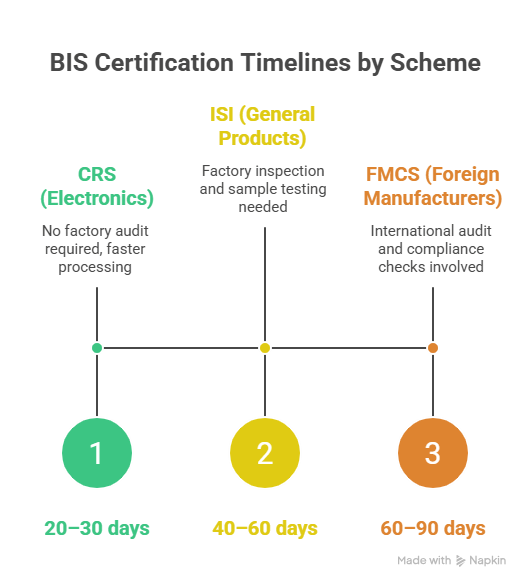
4. BIS Certification Timeline by Scheme
Not all certification journeys move at the same speed. The timeline depends less on urgency—and more on process complexity, verification depth, and audit requirements.
Here’s how the three primary BIS schemes stack up:
| Scheme | Timeline | Key Requirement |
| CRS (Electronics) | 20–30 days | No factory audit |
| ISI (General Products | 40–60 days | Factory inspection + sample testing |
| FMCS (Foreign Manufacturers) | 60–90 days | International audit + compliance checks |
Why These Timelines Differ
Because each scheme operates on a different level of scrutiny.
- CRS is the fastest because it runs on a self-declaration model. Once your product passes lab testing and documents are in place, there’s no physical factory inspection slowing things down.
- ISI takes longer because it’s process-heavy. BIS doesn’t just test your product—it evaluates your entire manufacturing ecosystem, from quality control systems to on-ground production practices.
- FMCS sits in the middle, but with a twist. While timelines can be shorter than ISI, the logistics are heavier— cross-border audits, international lab coordination, and regulatory alignment all add layers of complexity.
5. Key Challenges in BIS Certification
Common Bottlenecks
- Incorrect Standard Selection: Choosing the wrong Indian Standard (IS) is like starting with the wrong map. Everything—from testing to documentation—goes off-track, often forcing a restart.
- Documentation Errors: Incomplete forms. Mismatched details. Missing declarations. Small mistakes here don’t just delay—they compound. BIS scrutiny is precise, and inconsistencies raise red flags instantly.
- Failed Lab Tests: If your product doesn’t meet IS requirements during testing, the process halts. isn’t just about fixing the product—it often means retesting, re-documenting, and reapplying.
- Audit Non-Compliance: Factory inspections are unforgiving. Weak quality control systems, poor documentation practices, or process gaps can lead to non-conformity reports—and mandatory corrections within tight deadlines.
Why Delays Happen
Because BIS certification isn’t just documentation—it’s alignment.
Delays typically stem from:
- Lack of clarity in the initial stage
- Poor coordination between testing, documentation, and submission
- Underestimating audit readiness
- Treating compliance as a one-time task instead of a system
6. Pro Tips to Speed Up BIS Approval
Speed in BIS certification isn’t luck—it’s leverage. The applicants who move fastest aren’t cutting corners; they’re eliminating friction before it shows up.
Here’s how to do it right:
Pre-Validate Your Documents
Don’t wait for BIS to find mistakes—because they will.
Cross-check everything before submission:
- Names, addresses, and registrations must match across documents
- Product specifications should align with test reports
- Declarations must be complete and consistent
Think of this as a pre-audit. The cleaner your paperwork, the fewer loops you run.
Use BIS-Recognized Labs Early
Testing isn’t a step—it’s a gatekeeper.
Engage BIS-recognized labs (NABL/ILAC) early in the process:
- It gives you clarity on compliance gaps upfront
- Reduces the risk of failed reports later
- Helps you plan around the 90-day validity window
Late testing compresses timelines. Early testing gives you control.
Align Factory QC with IS Requirements
For ISI and FMCS routes, your factory isn’t just inspected—it’s examined.
Before the audit:
- Ensure your quality control systems mirror IS standards
- Document every process clearly
- Train your team on compliance expectations
Because during inspection, BIS isn’t just asking: Does your product meet standards? They’re asking: Can you consistently maintain them?
Consider the Simplified Route
If you’re a domestic manufacturer with everything in place, the simplified procedure can significantly cut timelines.
- Faster approvals (as quick as ~30 days)
- Based on self-evaluation and complete documentation
- Ideal for applicants who are already compliance-ready
7. Conclusion
The BIS certification process, when stripped down, is straightforward: Identify → Prepare → Apply → Verify → Approve → Mark.
But execution is where most businesses falter.
In 2026, compliance is no longer a backend function—it’s a frontline business requirement. With expanding Quality Control Orders and stricter enforcement, BIS certification has moved from regulatory checkbox to market access passport.
The difference between a 30-day approval and a 6-month delay rarely lies in the system.
It lies in how prepared you are before you enter it.
Final takeaway:
- If you treat BIS certification as a process, it will take time.
- If you treat it as a system to prepare for, it will move faster.
And in a compliance-first market, faster doesn’t just mean efficient—it means competitive.
FAQ-
- How long does BIS certification take?
The timeline typically ranges from 30 to 120 days, depending on the certification scheme.
- CRS (Electronics): 20–30 days
- ISI (Domestic Manufacturing): 40–60 days
- FMCS (Foreign Manufacturers): 60–90 days
Faster approvals are possible under the simplified process, provided your documentation and testing are already in place.
- Is BIS certification mandatory for all products?
No—but for products covered under Quality Control Orders (QCOs), it is absolutely mandatory.
If your product falls under a notified category, you cannot manufacture, import, or sell it in India without BIS certification. Non-compliance can lead to penalties, product seizures, or legal action.
- Can foreign manufacturers apply for BIS certification?
Yes. Foreign manufacturers can apply through the FMCS (Foreign Manufacturers Certification Scheme).
This allows overseas companies to export products to India, but it involves:
- Factory audits
- BIS-recognized testing
- Appointment of an Authorized Indian Representative (AIR)
4. What happens if a product fails BIS testing or audit?
If your product or factory fails to meet Indian Standards:
- BIS may issue a non-conformity report
- You typically get 30 days to rectify the issue
- Re-testing or re-audit may be required
Failure to resolve issues can result in application rejection or delays.
5. What are the penalties for non-compliance with BIS certification?
Non-compliance isn’t just a technical issue—it’s a legal one.
Penalties may include:
- Fines up to ₹20 lakh
- License suspension or cancellation
- Imprisonment in severe cases
In short: operating without for BIS certification (when required) can shut down your market access entirely.