

1. Why BIS Certification Matters in 2026
India isn’t just growing—it’s tightening the screws.
In 2026, the country’s quality control ecosystem has shifted from recommended compliance to non-negotiable enforcement . More products. More scrutiny. More consequences. Whether you’re manufacturing in Delhi or exporting from Shenzhen, the message is blunt: meet the standard, or stay out of the market.
At the center of this shift sits BIS certification—a regulatory gatekeeper that decides what gets sold and what gets stopped at the border.
BIS certification is a government-backed assurance that a product meets India’s prescribed quality, safety, and reliability standards.
And here’s where it gets serious: the list of regulated products has exploded. Electronics, batteries, toys, steel, even everyday consumer goods—now pulled under mandatory compliance through expanding Quality Control Orders. Enforcement isn’t just stricter; it’s smarter, backed by traceability rules and tighter surveillance.
This guide cuts through the noise.
No vague definitions. No compliance jargon overload. Just a clear, structured breakdown of what BIS certification is, who needs it, how it works, and what’s changed in 2026—so you can move fast, stay compliant, and avoid costly missteps.
2. What is BIS Certification?
BIS certification is India’s official stamp of trust—a signal that a product has been tested, verified, and approved against established national standards.
It exists to ensure that what reaches consumers isn’t just functional, but safe, reliable, and consistent in quality. Behind that simple mark lies a structured system of standards, testing protocols, and regulatory oversight.
Legally, BIS operates under the Bureau of Indian Standards Act, 2016 , which gives it the authority to define standards and enforce compliance across industries. The organization functions under the Ministry of Consumer Affairs , anchoring its role firmly in public interest rather than just industrial regulation.
The purpose is twofold:
- Standardization — creating uniform benchmarks across products and sectors
- Consumer protection — preventing substandard or unsafe goods from entering the market
In short, BIS certification isn’t just a label—it’s a filter. One that separates compliant products from everything that doesn’t belong on Indian shelves.
3. What is the Bureau of Indian Standards (BIS)?
If BIS certification is the stamp, the Bureau of Indian Standards (BIS) is the authority holding the seal.
As India’s national standards body, BIS sits at the intersection of regulation, industry, and consumer safety. Its job isn’t just to set rules —it’s to define what “quality” actually means across thousands of products moving through the Indian market.
At the core of its work lies the development of Indian Standards (IS) —technical benchmarks that specify how a product should perform, how safe it must be, and how consistent its quality needs to remain. These standards stretch across sectors: from electronics and IT goods to chemicals, steel, machinery, and everyday consumer items.
But BIS doesn’t stop at writing standards—it enforces them.
Through certification and marking schemes like ISI and CRS , BIS verifies whether products actually meet these benchmarks before they reach consumers. That small mark on a product? It’s not decorative—it’s a signal that the product has cleared a defined compliance pathway.
The real impact is market-wide. BIS acts as a filter, systematically blocking substandard or unsafe goods from entering circulation. It creates a baseline of trust—so buyers don’t have to second-guess what they’re purchasing.
And beyond compliance, BIS plays a strategic role. By aligning Indian products with recognized standards, it strengthens initiatives like Make in India , boosting both domestic manufacturing credibility and global export potential.
In essence, BIS doesn’t just regulate quality—it engineers confidence into the market.
4. Types of BIS Certification Schemes (2026 Breakdown)
BIS certification isn’t a one-size-fits-all system. It’s a structured framework of schemes—each designed for specific product types, risk levels, and manufacturing contexts.
In 2026, understanding these schemes isn’t optional. It’s the difference between smooth market entry and regulatory deadlock.
4.1 Mandatory Certification Schemes
These are the backbone of BIS enforcement—schemes that apply to products under compulsory certification.
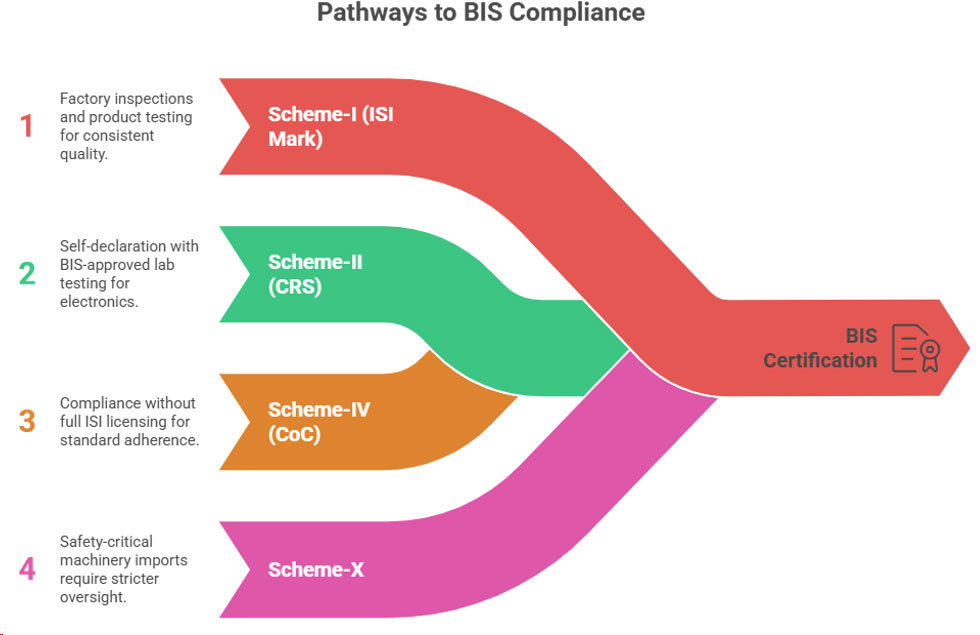
Scheme-I (ISI Mark Scheme)
The most recognized mark in India. This scheme involves factory inspections and product testing , ensuring consistent quality at the manufacturing level before granting the ISI mark.
Scheme-II (CRS – Compulsory Registration Scheme)
Built for electronics and IT products, CRS operates on a self-declaration basis , backed by testing in BIS-approved labs. Think smartphones, LED lights, and other high-volume consumer tech.
Scheme-IV (Certificate of Conformity – CoC)
A compliance pathway focused on ensuring that products meet prescribed standards without the full ISI-style licensing structure.
Scheme-X
Designed specifically for high-risk machinery , particularly for foreign manufacturers. This scheme addresses safety-critical imports that require stricter oversight before entering India.
4.2 Voluntary vs Mandatory Certification
Not every product starts as mandatory—but many end up there.
BIS offers voluntary certification schemes , allowing manufacturers to adopt standards proactively, often as a signal of quality and credibility. But the real shift comes through Quality Control Orders (QCOs).
QCOs are government notifications that flip the switch—turning voluntary standards into legal requirements.
As of 2026, over 679 product categories fall under mandatory BIS certification. And the list is growing.
The pattern is clear: what’s optional today can become compulsory tomorrow.
4.3 Certification for Foreign Manufacturers
India’s standards don’t stop at its borders—and neither does BIS.
Foreign manufacturers looking to sell in India must comply through specific pathways:
FMCS (Foreign Manufacturers Certification Scheme)
This allows overseas manufacturers to obtain BIS certification, typically aligned with the ISI mark framework, including audits and testing.
Scheme X (for high-risk imports)
Used when dealing with sensitive or high-risk machinery, ensuring stricter compliance before products enter the Indian market.
For exporters, BIS certification isn’t just paperwork—it’s a market entry requirement . Without it, products risk being denied clearance, delayed, or outright rejected.
In a compliance-first India, certification is no longer a backend process. It’s the front door.
5. Who Needs BIS Certification in India?
Short answer? Almost everyone touching a regulated product.
In 2026, BIS certification isn’t limited to manufacturers—it extends across the entire supply chain. If you’re involved in bringing a product to the Indian market, compliance likely sits on your desk.
Manufacturers (Domestic & Foreign)
Whether producing locally or overseas, manufacturers must ensure their products meet applicable Indian Standards before entering the market.
Importers
If you’re bringing goods into India, the responsibility doesn’t stop at logistics. You’re accountable for ensuring the product is BIS-certified before it clears customs.
Traders & Distributors
Selling or distributing notified products without certification? That’s a direct violation. Retail doesn’t dilute responsibility—it extends it.
At its core, BIS certification is a legal requirement prior to sale in India . Not post-launch. Not optional. Pre-market entry.
5.1 Consequences of Non-Compliance
Ignore BIS, and the system doesn’t gently warn—you get hit.
Fines
Financial penalties that can scale depending on the violation.
Product Seizure
Non-compliant goods can be confiscated, halting distribution instantly.
Imprisonment Risks
In serious cases, especially repeated violations, legal action can escalate to imprisonment.
This isn’t regulatory theatre. It’s enforcement with teeth.
5.2 Expanded Scope in 2026
What’s changed? The net has widened—and it’s still expanding.
Entire categories that once operated in grey zones are now firmly regulated:
Electronics — smartphones, power banks, smart devices
Industrial Materials — steel and related products
Consumer Goods — toys, appliances
Emerging Tech — lithium batteries and energy storage devices
The direction is unmistakable: more products, tighter control, deeper scrutiny.
Compliance is no longer industry-specific—it’s ecosystem-wide.
6. List of Products Covered Under BIS (2026)
BIS certification spans a broad—and growing—range of product categories. While the exact list evolves, certain sectors remain consistently under the regulatory spotlight.
6.1 Electronics & IT Products
This is one of the most tightly regulated segments under BIS.
Examples include:
- Mobile phones
- Laptops
- LED lights
- CCTV cameras
- IoT devices
Applicable Scheme: CRS (Compulsory Registration Scheme)
These are high-volume, high-impact products—making compliance both critical and closely monitored.
6.2 Jewellery
Precision meets regulation here.
Gold and silver articles fall under mandatory certification through hallmarking.
As of the 2026 update , hallmarking requirements have expanded to more districts under a phased rollout.
For jewellers, certification is no longer a differentiator—it’s a baseline expectation
6.3 Other Regulated Products
Beyond electronics and jewellery, BIS extends into core industrial and consumer sectors:
- Steel products
- Chemicals
- Toys
- Batteries
- Household appliances
Applicable Schemes: ISI Mark / CRS (depending on product category)
This mix reflects BIS’s dual focus: heavy industry + everyday consumer safety.
6.4 Note on Dynamic Product Lists
Here’s the catch: the BIS product list isn’t static.
Categories are regularly updated through government notifications and Quality Control Orders (QCOs) . New products get added. Existing requirements get tightened.
Which means one thing— assumptions are risky.
For accurate, up-to-date compliance, businesses must regularly check official BIS sources and notifications. Because in this system, being “almost compliant” is the same as being non-compliant.
7. BIS Certification Process (Step-by-Step Guide)
Strip away the bureaucracy, and the BIS certification process follows a clear logic: define → test → verify → approve → mark .
But each step matters—and missing one can stall everything.
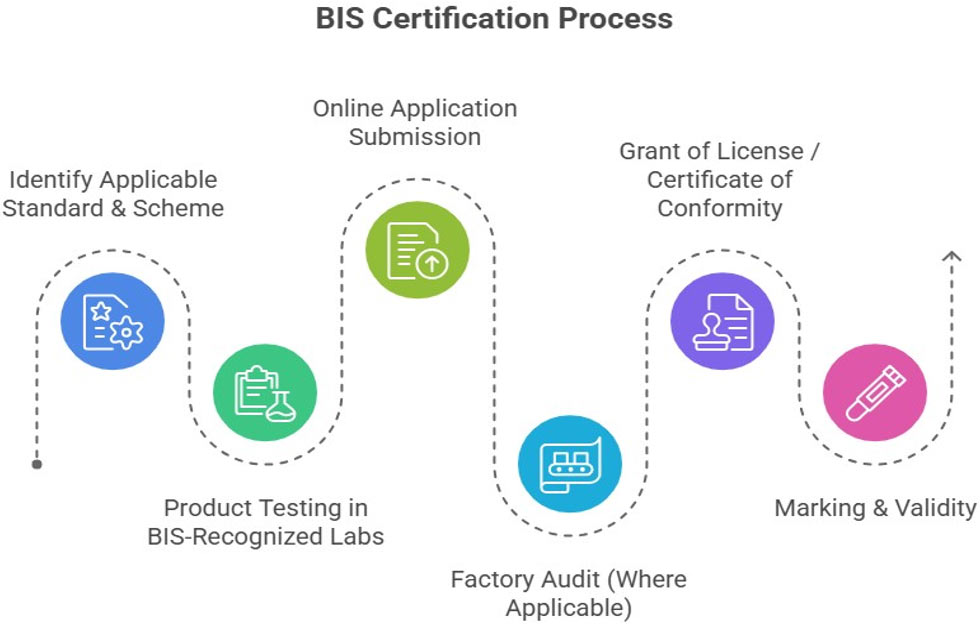
Step 1: Identify the Applicable Standard & Scheme
Everything starts here.
You need to determine the relevant Indian Standard (IS) for your product and map it to the correct certification scheme—ISI, CRS, or others. Get this wrong, and you’re building on faulty ground.
Step 2: Product Testing in BIS-Recognized Labs
Before anything goes live, your product must be tested.
Samples are sent to BIS-approved laboratories , where they’re evaluated against the applicable standards. This is where compliance shifts from theory to evidence.
Step 3: Online Application Submission
Once testing is complete, it’s time to file.
You submit an online application along with:
- Test reports
- Technical documents
- Product details
Accuracy here isn’t optional—documentation gaps can delay approvals significantly.
Step 4: Factory Audit (Where Applicable)
For schemes like ISI and FMCS , BIS goes beyond paperwork.
A factory inspection is conducted to verify:
- Manufacturing processes
- Quality control systems
- Consistency in production
This ensures the product isn’t just compliant once—but consistently compliant.
Step 5: Grant of License / Certificate of Conformity
Clear the checks, and BIS issues approval.
Depending on the scheme, you receive:
- A BIS license (ISI)
- Or a Certificate of Conformity (CoC)
This is your official entry pass into the Indian market.
Step 6: Marking & Validity
Once approved, products must carry the appropriate mark:
- ISI Mark
- CRS Registration Mark
As per the 2026 update , certification is now valid for up to 5 years , reducing renewal friction—but increasing the importance of ongoing compliance.
8. Benefits of BIS Certification
BIS certification isn’t just about avoiding trouble—it’s about unlocking advantage.
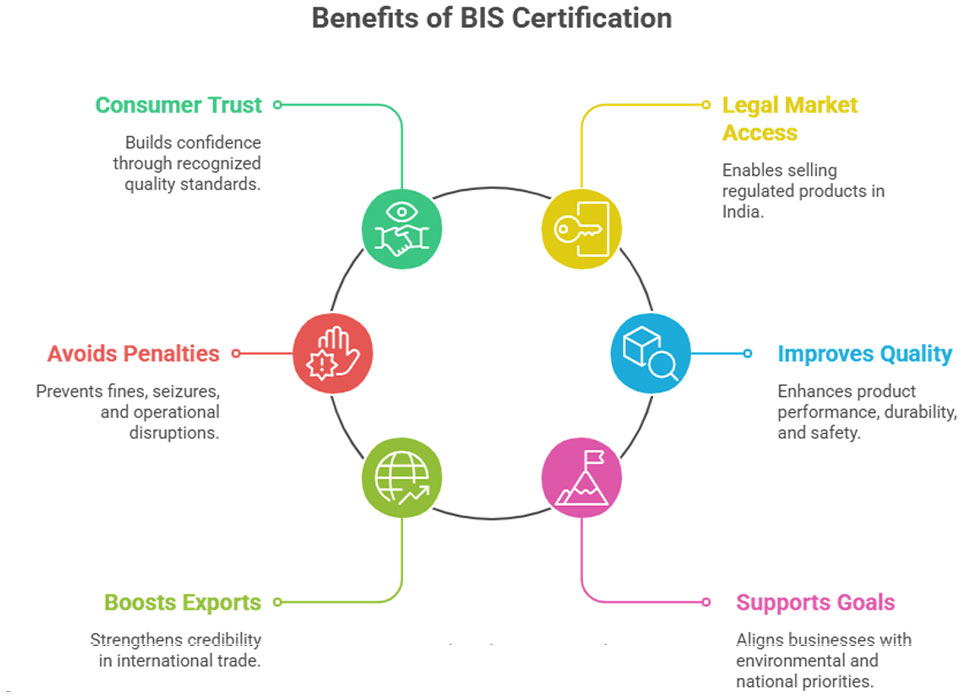
Builds Consumer Trust
That certification mark signals credibility. It tells buyers the product meets defined safety and quality benchmarks—no guesswork required.
Legal Market Access in India
For regulated products, BIS certification isn’t a bonus—it’s the key to entry . Without it, selling in India isn’t legally possible.
Avoids Penalties and Disruptions
Compliance keeps operations smooth. No seizures. No fines. No sudden shutdowns.
Improves Product Quality and Safety
The process forces alignment with tested standards—raising the baseline for performance, durability, and safety.
Boosts Export Potential
Standardized products carry more weight globally. BIS certification strengthens credibility in international trade.
Supports Environmental & National Goals
By enforcing quality and safety norms, BIS aligns businesses with broader priorities—consumer protection, sustainability, and structured industrial growth.
In a compliance-driven market like India, BIS certification isn’t just a requirement—it’s leverage.
9. Key BIS Updates in 2026
If previous years were about expansion, 2026 is about tightening the system.
The framework hasn’t just grown—it’s become sharper, more traceable, and harder to bypass. Here are the updates that matter: License Validity Extended to 5 Years
A practical shift with strategic impact.
BIS licenses now come with a validity of up to 5 years , reducing renewal frequency and administrative overhead. But don’t mistake longer validity for relaxed oversight—compliance still needs to be maintained continuously.
CRS Traceability Requirements Introduced
This is where enforcement gets smarter.
Under the CRS scheme , new traceability rules ensure that products can be tracked back to their source—linking batches, manufacturers, and certifications more tightly than before.
The result? Less room for mislabeling. More accountability across the supply chain.
Hallmarking Expanded (6th Phase Districts)
Jewellery regulation continues its steady rollout.
The 6th phase of hallmarking expansion brings more districts under mandatory certification for gold and silver articles—closing regional gaps and standardizing quality nationwide
New Product Inclusions: Smart Devices & Batteries
The product list keeps evolving—with a clear focus on modern tech.
In 2026, BIS has expanded coverage to include:
- Smart devices (IoT-based products)
- Advanced batteries, including lithium-based systems
These additions reflect changing consumption patterns—and the risks that come with them.
Mandatory Annual Production Statements & Fees
Compliance is no longer a one-time event.
Manufacturers are now required to submit annual production data along with applicable fees. This introduces an ongoing reporting layer—keeping BIS visibility active even after certification is granted.
Put together, these updates signal one thing:
India isn’t just certifying products anymore—it’s monitoring them.
11. Conclusion: Navigating BIS Certification in a Stricter India
India’s compliance landscape has crossed a line—and there’s no going back.
BIS certification is no longer a procedural checkbox tucked away at the end of production. It’s frontline business strategy. If your product falls under regulation—and most do in 2026—compliance isn’t optional. It’s the price of entry.
What makes this shift sharper is the pace of change. Standards are evolving. Product categories are expanding. Enforcement is getting smarter, more traceable, and far less forgiving. The system isn’t static—it’s actively tightening.
Which leaves businesses with a clear choice: adapt early or scramble later.
Because at its core, BIS certification does two things—it unlocks access and builds trust.
Access to one of the world’s fastest-growing markets.
Trust from consumers who expect safety, quality, and consistency.
Miss it, and you’re locked out.
Get it right, and you’re not just compliant—you’re competitive.
FAQs: BIS Certification in India (2026)
Is BIS certification mandatory for all products in India?
No—but for a rapidly growing list of products, it absolutely is. BIS certification becomes compulsory when a product is covered under a Quality Control Order (QCO) . As of 2026, 679+ product categories fall under mandatory certification, and the list continues to expand.
How long does it take to get BIS certification?
Timelines vary depending on the scheme and product complexity. Typically, it can take 4 to 12 weeks , including testing and documentation. However, under the Tatkal scheme (for domestic manufacturers), approval can be fast-tracked to around 30 days .
Can foreign manufacturers apply for BIS certification?
Yes. Foreign manufacturers can obtain BIS certification through schemes like FMCS (Foreign Manufacturers Certification Scheme) or Scheme X for high-risk machinery. Certification is mandatory before exporting regulated products to India.
What happens if I sell a product without BIS certification?
Non-compliance carries serious consequences. Authorities can impose fines, seize products, and even initiate imprisonment proceedings in severe cases. It can also lead to shipment rejections and business disruptions.
How can I check if my product requires BIS certification?
The most reliable way is to check official BIS notifications and QCOs on the BIS website. Since product lists are frequently updated, relying on outdated information can put your business at risk. Regular verification is essential.